Site prep is everything that turns raw ground into a formed-ready building site: clearing and grubbing, a topsoil strip, cut and fill to grade, a compacted pad at the design elevation, and the foundation dig. In the Fraser Valley a shop or garage pad commonly runs $3,000 to $10,000, and full site prep for a new home runs $10,000 to $30,000.
What Does Site Prep Actually Include?
Site preparation is everything that has to happen to a piece of ground before a foundation can be formed on it: clearing vegetation, stripping topsoil, cutting high spots and filling low ones, building a compacted pad at the right elevation, and digging the foundation itself. In the Fraser Valley, where a single municipality can contain river silt, glacial till and bedrock, good site prep is the difference between a slab that stays flat for fifty years and one that cracks in five.
We prepare sites for new homes, shops, detached garages, barns and coach houses across Abbotsford, Chilliwack, Mission, Langley and the surrounding communities. A lot of our work is on acreages and farm properties, where the building site has to be carved out of a working landscape: a shop pad beside the house, a barn on the back of the property, a coach house where the old garden used to be.
What Order Does Site Prep Happen In?
Six stages, always in the same order, because each one depends on the last. Skipping or reordering them is where settlement, cracked slabs and wet basements come from.
- Clearing and grubbing. Brush, small trees, stumps and roots come out of the building footprint and the access route. Organic material cannot stay under a pad, because it rots and settles. See our land clearing page for larger clearing jobs.
- Topsoil strip. Topsoil is stripped from the footprint and stockpiled on site where possible. It is valuable material for final landscaping, and keeping it saves you buying it back later at market price.
- Cut and fill to grade. High ground gets cut, low ground gets filled, and the fill goes down in compacted lifts, not one loose push. On sloped lots we bench the cut so fill keys into the hillside instead of sliding on it.
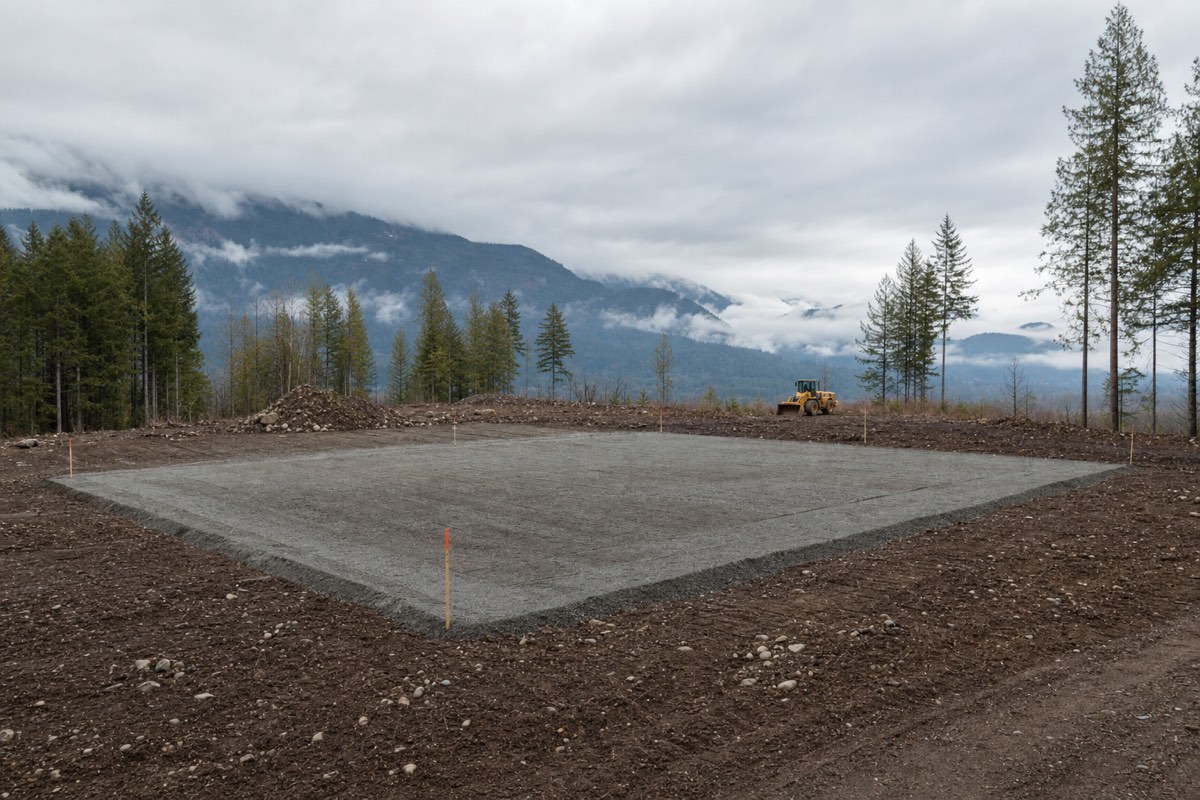
- Building pad construction. The pad is built from suitable structural fill, compacted lift by lift, and finished to the design elevation on your drawings. For shops and garages this is usually the whole job; for houses it sets up the foundation dig.
- Foundation excavation. Footings and foundation walls are dug to the elevations and dimensions on the structural drawings, with room to work and with spoil either stockpiled for backfill or hauled off.
- Backfill and rough grade. After the foundation is poured, damp-proofed and drained, we backfill against the walls and rough grade the lot so water sheds away from the building from day one.
How Do Soil and Season Change the Job?
They are the two biggest swing factors in any quote. Soil decides how much material has to be removed and replaced; season decides whether it can be compacted at all.
Fraser Valley soils range from deep silt on the prairies to clay hardpan in Langley and Abbotsford uplands to shallow rock on Sumas Mountain and the Mission hillsides. Each behaves differently under a machine and under a building. Silt and clay hold water and lose strength when wet; till and gravel drain well and compact beautifully; rock means blasting or hoe-ramming if your elevations demand it.
Season matters just as much. From roughly October to March, the valley's fine-grained soils are saturated. Machines rut them, compaction targets become hard to hit, and money gets spent fixing ground that would have been fine in July. We schedule earthworks honestly: if your pad should wait eight weeks for the site to dry, we say so, because rework costs you more than patience does.
Typical Fraser Valley machine rates, which we convert into a firm quoted price once a scope like a pad or a foundation dig is defined:
| Machine | Typical rate with operator | Usual minimum |
|---|---|---|
| Mini excavator | $130 to $180 per hour | Half day |
| Mid-size excavator | $160 to $220 per hour | Half day |
| Tandem dump truck | $120 to $160 per hour | Half day |
| Shop or garage pad (defined scope) | $3,000 to $10,000 quoted | Quoted per project |
| Full site prep, new home (defined scope) | $10,000 to $30,000 quoted | Quoted per project |
What Permits and Locates Do You Need First?
At minimum a BC 1 Call locate request, and usually a municipal soil permit if material is coming in or going out. Building permit drawings set your pad elevations.
Most Fraser Valley municipalities regulate soil movement beyond small volumes. Abbotsford and Chilliwack both have soil removal and deposit bylaws, and building on fill or in a floodplain can trigger additional requirements. Your building permit drawings will set pad elevations, especially in flood construction level areas near the Fraser, Sumas and Vedder rivers. We work to those numbers and coordinate with your builder, designer or engineer.
If material is coming onto the property or leaving it, check the volume thresholds first: our guide to soil and fill permits in the Fraser Valley sets out what each city allows before a permit is required.
Before any digging, a BC 1 Call locate request goes in, at least three business days ahead, so gas, hydro and telecom services are marked. It is free, it is required practice, and we treat it as non-negotiable. Private services (septic fields, irrigation, wiring to outbuildings) are not in the BC 1 Call database, so we also walk the property with you and flag anything the records do not show.
What Does a Shop or Garage Pad Involve?
Shop and garage pads are our bread and butter on acreage properties. A typical job: strip the footprint, dig out soft or organic material, place and compact structural fill, finish with a tight lift of crushed gravel at slab grade, and tie the new pad into a gravel driveway or yard area so concrete trucks and daily traffic have a solid surface. If the shop needs power or water from the house, we trench the services while the machine is already on site, which saves you a second mobilization charge.
Why Use One Contractor for the Whole Sequence?
Because every handoff between trades is a mobilization charge and a place for the schedule to fall through.
Splitting clearing, digging, hauling and grading across multiple outfits multiplies mobilization charges and creates gaps where nobody owns the schedule. We run the sequence as one job: machine, operator, trucks and disposal coordinated together, one point of contact, one firm quote. When your forming crew shows up, the site is at grade, compacted, drained and clean.
Frequently Asked Questions
How much does site prep cost for a new house or shop in the Fraser Valley?
Typical site prep for a shop or garage pad on an already-accessible lot often lands in the $3,000 to $10,000 range, while full site prep for a new home (clearing, grubbing, cut and fill, foundation excavation and rough grading) commonly runs from $10,000 to $30,000 or more depending on the lot. The honest answer is that it depends on slope, soil, access and how much material has to move, which is why we quote from a site visit, not over the phone.
Do I need a geotechnical report before site prep?
For many new builds in the Fraser Valley, yes, your municipality or your engineer will require one, especially on sloped lots in Mission or on Sumas Mountain, on fill sites, and in floodplain areas. The geotech tells everyone what the soil can bear and how deep footings need to go. We work to the geotech and structural drawings, and we can dig test pits with the excavator so the engineer can see undisturbed soil before final design.
How level does a building pad really need to be?
A properly built pad is more than level: it is cut to design elevation, built up in compacted lifts of suitable fill, and proof-rolled so it does not settle after the concrete goes down. Foundations forgive very little, so we grade pads to tight tolerance and compact lift by lift. A pad that was pushed together in one loose dump of fill is the most common cause of cracked slabs we see.
When is the best time of year to do site prep?
The dry season, roughly April through September, is the right window for most Fraser Valley site prep because native soils are workable and engineered fill compacts reliably. In the wet months, clay and silt subgrades get pumped into mud by machine traffic, which costs you money in wasted time and replacement gravel. If your build schedule allows it, prep the site in summer and pour in fall.
Can you dig the foundation too, or just prep the lot?
We do both. A typical package takes the lot from raw to ready: clear and grub, strip and stockpile topsoil, cut and fill to design grade, excavate the foundation to the elevations on your drawings, and backfill and rough grade after the foundation is poured and drained. One contractor for the whole sequence keeps the schedule and the responsibility in one place.